Fixing a type lie in Spotify's official TypeScript SDK
How a typing bug I hit as a user of Spotify's web-api-ts-sdk turned into a merged PR, and the TypeScript trick that made it possible.
For a while I was writing my own Spotify API client in TypeScript, around the same time
Spotify's own team was building their official one. The two ended up fairly close in shape
(which made sense, we were both wrapping the same API), but there's only one outcome when an
official SDK exists: people use the official one. Mine quietly stopped mattering the day
spotify-web-api-ts-sdk shipped, and that was fine. I switched my own project over to it
like everyone else.
Being a user of a library you almost wrote yourself is a strange position: you read the source
differently, you notice things faster. A few weeks in, I noticed something in the search
endpoint's types that was just wrong.
The bug: the types promised more than the API delivers
Spotify's search endpoint takes a list of resource types to search across (track, artist,
album, and so on), and its own documentation is explicit about what comes back: only the
keys you asked for are present in the response. Search for tracks and artists, and you get
tracks and artists back. You do not get albums: undefined sitting in the payload for every
type you didn't ask for.
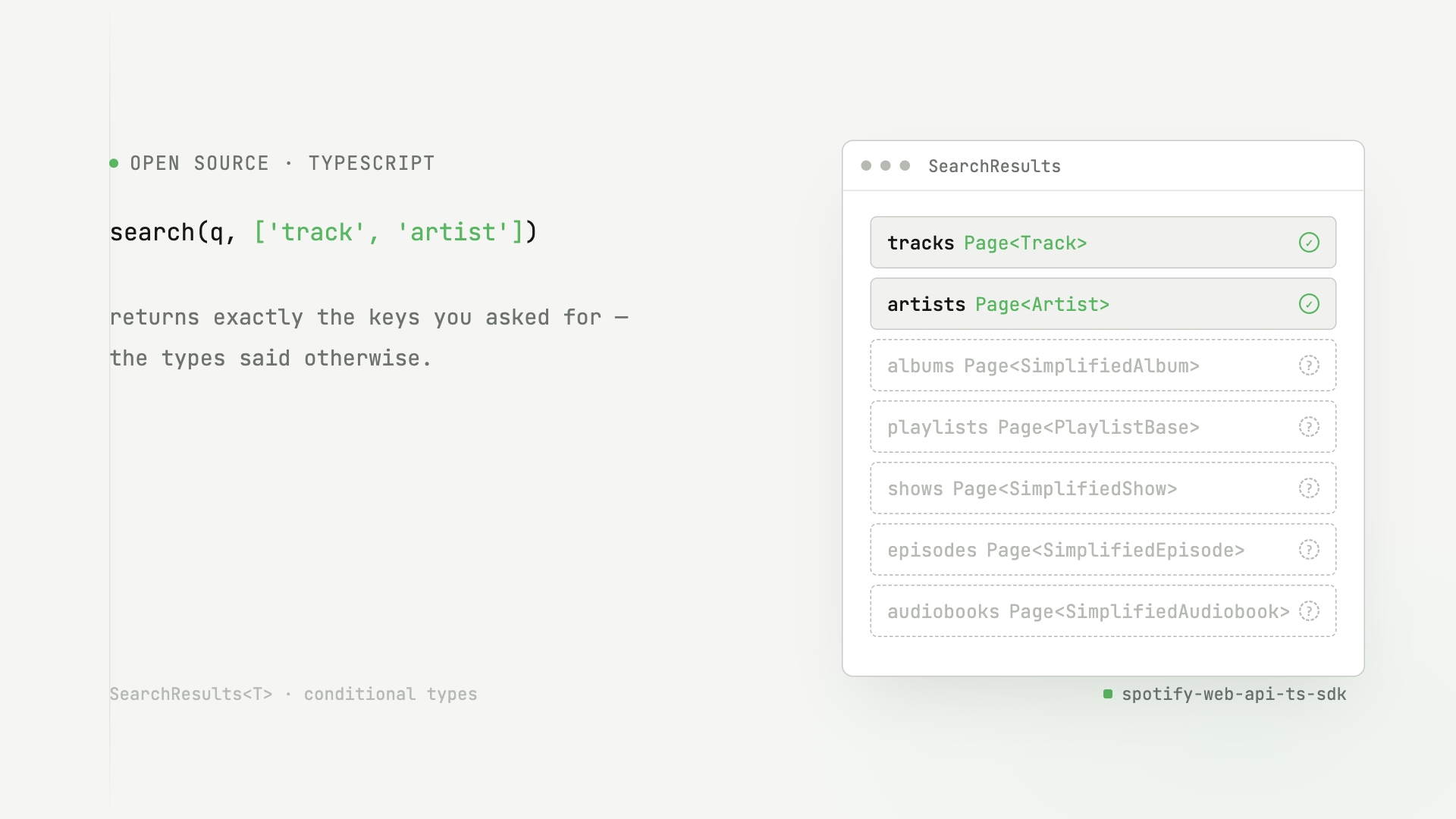
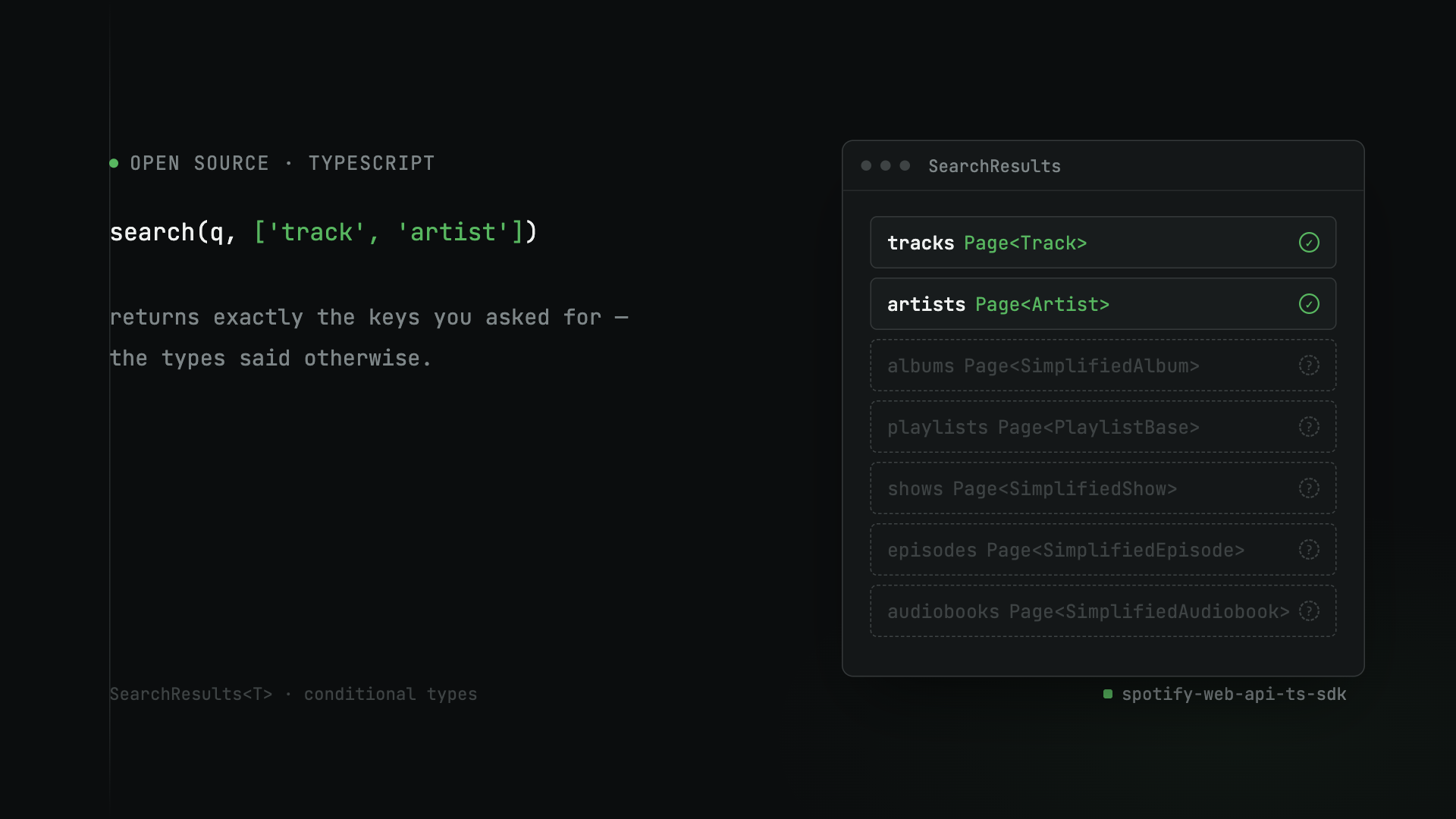
The SDK's typings disagreed. Every property on the search result type was declared as always present:
interface SearchResults {
  tracks: Page<Track>
  artists: Page<Artist>
  albums: Page<SimplifiedAlbum>
  playlists: Page<PlaylistBase>
  shows: Page<SimplifiedShow>
  episodes: Page<SimplifiedEpisode>
  audiobooks: Page<SimplifiedAudiobook>
}
In practice, TypeScript would happily let you write result.albums.items after searching for
track only. It compiles fine, then hands you a runtime crash the moment that code actually
runs, because albums was never in the response to begin with. It's about the worst kind of
typing bug: it doesn't just fail to help, it actively lies to the compiler on your behalf.
The fix sounds simple in one sentence: make every property optional. But that's not quite right either, and this is the part that actually made the problem interesting.
Why "just make it all optional" isn't good enough
If you search with a literal, fixed list of types, say search(q, ['track']), TypeScript can
know exactly what's coming back. In that case the type checker should be able to tell you
result.tracks is definitely there, no optional chaining needed. It's only when the list of
types isn't known at compile time (a string[] built at runtime, for example) that the compiler
can't promise anything, and every property should be optional.
The real requirement, then, was to make properties optional except when TypeScript can
statically prove which ones will exist. That's not a straightforward "add a ? to everything"
fix. It needs the type to behave differently depending on whether the input is a fixed tuple or
an open array, decided entirely at the type level.
I wasn't sure this was even expressible in TypeScript's type system, so I asked on Stack Overflow, worried it might not be feasible at all: Typescript: Make all properties optional unless explicited when using a literal type.
Twenty minutes later, wonderflame posted an answer that was one of the best pieces of TypeScript explanation I've read on that site. It didn't just hand me a type, it built the reasoning up from first principles, step by step, enough that I could turn it directly into a pull request. Here's that reasoning, laid out the way it earned it.
The trick, step by step
Step 1: detect whether an array is a fixed tuple or an open array
The whole problem hinges on being able to distinguish two shapes that look similar at a glance
but aren't: a fixed-length tuple like ['track'] versus an open-ended array like string[].
TypeScript exposes a way to tell them apart through the array's length property:
type Case1 = [1, 2, 3]["length"]
//   3

type Case2 = number[]["length"]
//   number
A tuple's length resolves to a literal number. An array's length resolves to the general
type number. That difference is exactly the hook we need: if number extends the array's
length type, it's not a tuple:
type IsTuple<T extends readonly unknown[]> =
  number extends T["length"] ? false : true
(readonly is there so this also matches as const tuples, which are a readonly supertype of
the mutable array.)
Step 2: make the search function generic over the exact input
Next, the function signature needs to capture the specific array that was passed in, not just
widen it to ItemTypes[]. That means a generic const type parameter (TypeScript 5.0+, though a
const assertion at the call site achieves the same thing on older versions):
declare const search: <const T extends readonly ItemTypes[]>(
  types: T,
) => unknown //  ^ to be replaced below
Step 3: build the result type from the requested keys
With T captured, T[number] gives every individual element type in the array, which is enough
to Pick only the relevant keys out of a type where everything is optional by default:
type Result<T extends readonly ItemTypes[]> =
  Pick<SearchResults, ResourceTypeToResultKey[T[number]]>
Step 4: flip optional to required, only for tuples
Last piece: feed that Pick through infer so it can be reused, then branch on IsTuple.
Non-tuple input keeps the properties optional. Tuple input gets wrapped in Required<...>:
type SearchResultsFor<T extends readonly ItemTypes[]> =
  Pick<SearchResults, ResourceTypeToResultKey[T[number]]> extends infer R
    ? IsTuple<T> extends false
      ? R
      : Required<R>
    : never

declare const search: <const T extends readonly ItemTypes[]>(
  types: T,
) => SearchResultsFor<T>

declare const dynamicTypes: ItemTypes[]
const case1 = search(dynamicTypes)
// { tracks?: Page<Track>, artists?: Page<Artist>, albums?: Page<SimplifiedAlbum> }

const case2 = search(["track"])
// { tracks: Page<Track> }
Search with a runtime-built array and tracks comes back optional, exactly matching what the
API can actually promise. Search with a literal tuple and TypeScript narrows it down to only the
keys you asked for, all required. No optional chaining needed, no lying to the compiler either
way.
Turning it into a PR
The actual PR to the SDK was almost a direct transcription of that answer into the
codebase's real types: SearchResults became generic over the requested tuple, the endpoint's
execute signature got the const T extends readonly ItemTypes[] treatment, and I added two
type-level tests with expectTypeOf to lock the behavior in for both cases, one asserting
optional properties for a non-literal array, one asserting required properties for a literal
tuple.
Small diff, about fifty lines including tests, and it went through review cleanly. Merged not long after.
Wrap-up
I keep coming back to how this whole thing started: not by planning to contribute to Spotify's SDK, just by using it for something of my own and tripping over a rough edge. That's basically how all my open-source contributions happen: I'm not trying to contribute, the library is just in my way and I fix what's broken for me. This one just happened to also teach me a TypeScript trick I didn't know existed.